The Coherence Compass
A Daily Guide for Living from Resonance Instead of Reaction

Preface
This document is a guide for anyone who has ever found themselves at a crossroads in an ordinary moment — wondering what the “right” choice is, feeling a subtle inner pull but also social pressure, confusion, or fear of consequence.
Whether you’re deciding:
to say yes or no to something you don’t actually want,
whether to speak up or stay quiet in a conversation,
or whether to honor your energy or override it in the name of politeness or fear —
this Compass walks you through how to discern what’s truly yours, and how to recognize the difference between your authentic signal and the internalized noise of people-pleasing, collapse, self-doubt, or inherited patterning.
It offers real-life examples — like saying ‘no’ in the face of fear, or navigating everyday social dynamics (like small talk when you don’t feel like speaking) — not to tell you what to do, but to show you how to notice.
It helps you understand:
what a threshold moment actually is and how it feels,
how each choice builds your base frequency,
and how coherence isn’t about perfection — but about gently, clearly, returning to what’s true.
This guide shall serve as a practical orientation tool designed to help you return to your tone — especially in challenging situations.
Whether you’re just beginning to listen inward, or have been walking the path of self-honesty for years, this Compass is here to meet you in the real moments of life — and help you walk them as the one you truly are.
The act of choosing your own tone — your truth — over what is accepted, expected, or comfortable for the external world (or your conditioned self) is rarely easy. It’s often subtle, confusing, and full of internal noise.
This for those ready to choose themselves — to recognize and trust their true tone over inherited roles, people-pleasing habits, and outsourced self-authority. It’s not about doing it perfectly. It’s about re-orienting, again and again, toward what’s real. And it offers the support many of us never received: clear examples, grounded guidance, and a way to feel your way back to coherence — in the middle of ordinary life.
This isn’t about getting somewhere.
It’s about returning — until that return becomes your baseline.
Most of us were taught, subtly or directly, to outsource our knowing.
We were encouraged to trade what felt true for what would be accepted.
To mistrust the exact tone we were born to live from.
So this isn’t about becoming something new.
It’s about unlearning everything that pulled you out of yourself — and re-patterning around your own field of truth.
That’s why it can feel disorienting.
You’re not just remembering who you are —
you’re de-authorizing everything that ever claimed to know you better than you did.
And that’s the real friction.
Not just fear or overwhelm — but a deep, cellular wrestle with authority:
“Who gets to say what’s true about me?”
“Is it safe to trust my own signal?”
This Compass becomes a re-tuning tool for exactly that moment —
when you’re ready to stop performing, stop shrinking, and start living from the coherence that was always yours.
What is Coherence?
Coherence is the natural state of a system in alignment with itself.
It means that all parts of you — mental, emotional, physical, and energetic — are in communication, resonating in harmony, and not working against each other.
In a coherent state, your thoughts match your deeper knowing.
Your actions are congruent with your truth.
Your body doesn’t have to compensate for what the field is suppressing.
And you begin to perceive reality clearly — not through fear, projection, or past conditioning, but through presence.
Most people are not living in this state.
Instead, they’re navigating life through a reactive field — shaped by old wounds, survival patterns, external expectations, and subconscious adaptation.
When you're in an incoherent state, it becomes difficult to tell what you actually want.
Your nervous system may be locked in threat mode, even when nothing is wrong.
Life feels like effort, fragmentation, or confusion.
You're not "wrong" in this state — it simply means your signal is out of sync with your deeper self.
What Coherence Feels Like
Coherence isn’t about getting everything “right.” It’s not control, performance, or spiritual perfection.
It’s a subtle, embodied state where your system is no longer working against itself. Your body softens, but you remain present and alert. You can speak or act without overthinking — not because you’re certain of the outcome, but because you’re anchored in your own clarity.
This is pragmatic, practiced trust — a felt sense of coherence in difficult situations that only you can truly recognize. Even when no one else sees it, you know what tone you’re holding.
The Compass exists as a tool for the mind, body, and field to return to — a stabilizing orientation point you can come home to, even in the middle of the storm.
Even in uncertainty, you feel grounded. You move not to earn validation or avoid disapproval, but because something in you is aligned. There’s no longer a split between what you feel and what you do.
This is not about becoming invulnerable. It’s about becoming internally synchronized.
Coherence is the natural vibrational state of your field when your body, awareness, and internal signal are in alignment.
You don’t have to force it. You remember it — and return.
What Incoherence Feels Like
Incoherence isn’t failure — it’s fragmentation. It’s what happens when parts of you are pulling in different directions: your body says one thing, your mind says another, and your actions try to please or protect rather than express what’s real.
You may find yourself looping in thought, replaying conversations, hesitating to act or speak. You might feel foggy, anxious, frozen — or urgently reactive, like you have to do something now or everything will fall apart.
Your energy leaks. Your boundaries blur.
You start asking:
“Is this what I actually want… or am I trying to avoid discomfort?”
“Am I doing this to be safe, liked, or acceptable?”
Incoherence often looks functional on the outside — but inside, it costs you.
And it compounds. The more often you override your truth, the harder it becomes to feel it at all.
But incoherence is not permanent.
It is simply a signal that you are out of sync with your deeper self — and an invitation to return.
PART ONE
The Threshold Moment: Tone, Override, or Collapse
Three practical real-life examples of discernment
Life is made of countless of small threshold moments.
“Something is happening. I have to choose what to do.”
Almost every day, we encounter them:
brief forks in the road where your body and field know one thing — but pressure, fear, or habit pull you toward another.
They often look ordinary:
a conversation, a small decision, a passing impulse.
But in these moments, you are shaping your frequency — reinforcing your tone or reinforcing your pattern.
This section walks you through real-life examples
of how to recognize those moments clearly —
and how to stay in your signal, even when it’s uncomfortable.
It’s not about always getting it right.
It’s about learning to feel the difference between:
Staying in tone
Overriding for approval
Collapsing to avoid tension
Each time you stay in tone,
you rewire your system toward coherence —
and life begins to reorganize around that.
Threshold moments often arise as:
A social interaction
A moment of expression or withholding
A fork in the road where two voices or impulses appear
Thresholds don’t only happen to people with social anxiety or people-pleasing conditioning.
They are universal energetic moments where something in your field knows the truth — but another part feels pressure, fear, or resistance to act on it.
For some, these moments come with the flavor of hesitation, caretaking, or overthinking.
For others, they show up as subtle tension, urgency, or split-second override.
Even those who appear confident or assertive encounter threshold moments.
They just meet a different edge — the edge of integrity under pressure.
What makes it a threshold is not the type of situation —
but the felt internal fork:
Do I stay with my tone,
or do I leave myself to protect something else?
This Compass helps you pause exactly there —
and choose a response that reinforces your coherence, instead of abandoning it.
The Three Ways: Tone, Override, or Collapse
Every threshold moment leads to one of three energetic directions.
They’re not good or bad — they’re just different ways your system responds when pressure meets truth.
This section helps you feel the difference.
It’s not about judging yourself.
It’s about learning how to recognize what’s happening in your field —
so you can pause, notice, and begin to choose alignment, rather than default patterns.
Each of these pathways carries its own frequency:
One keeps you intact.
One disconnects you from yourself.
One makes you disappear.
The more aware you become, the more clearly and consciously you can recognize which state you’re in — allowing you to re-claim your authenticity, again and again.
Each recognition is a return.
And with each return, you shift more powerfully —
not through force, but through compassion, trust, and presence.
Our choices are:
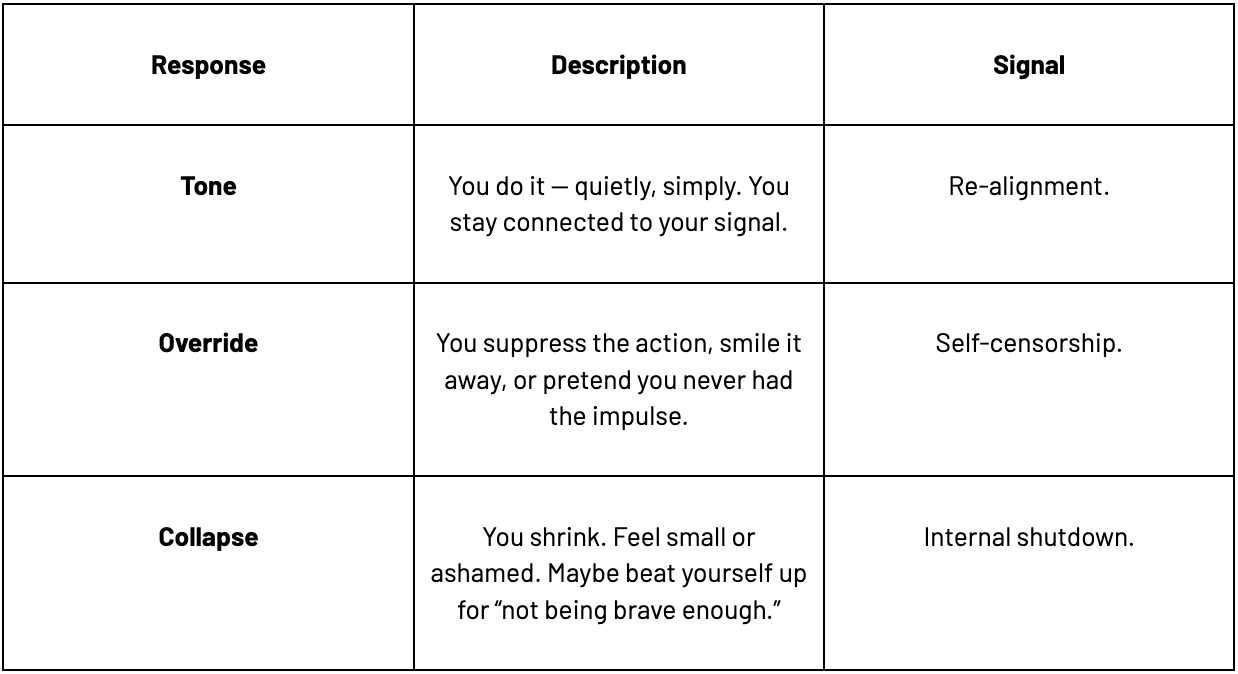
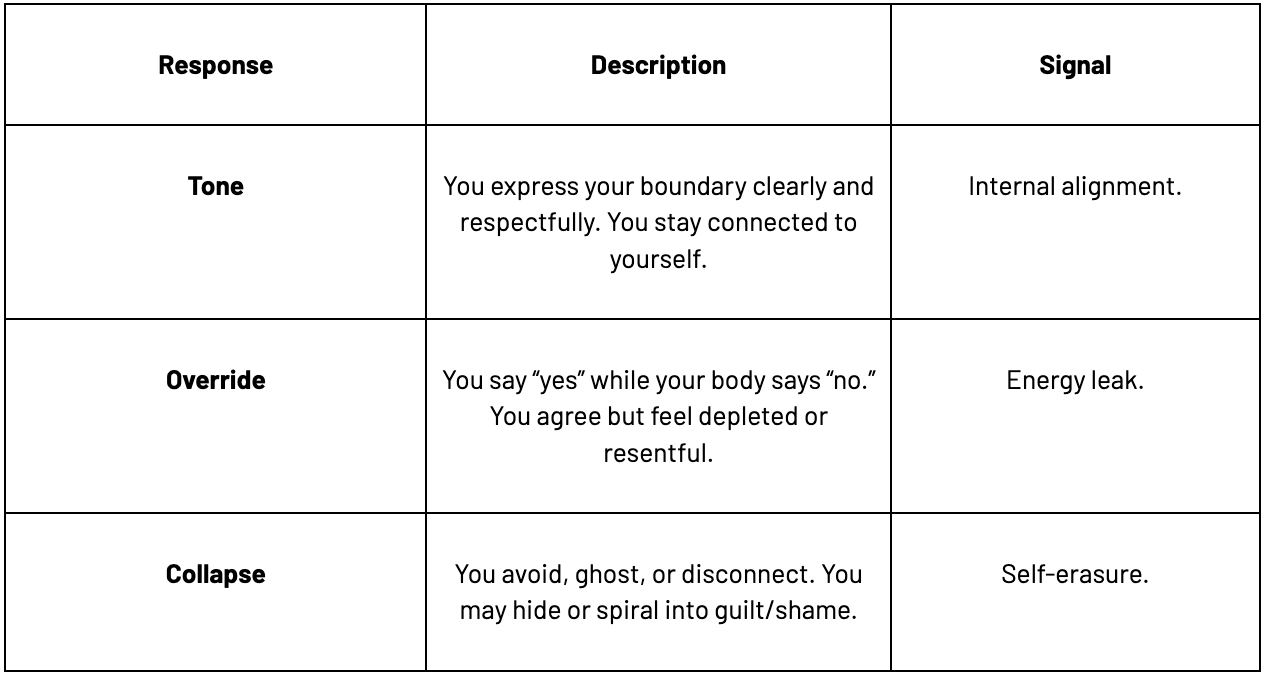
🟢 Tone
You stay with yourself.
You may feel discomfort, but you’re intact.
You speak or act from truth — not from pleasing, fear, or withdrawal.
🟡 Override
You perform.
You override your real feeling to “keep it nice” or “get it right.”
This can look friendly — but you’ve left your own signal.
🔴 Collapse
You avoid.
You don’t speak when something is true.
You stay small, disappear, or comply from fear — not clarity.
The Threshold Sequence: Our Moment of Choice
Every threshold moment can feel messy in real time.
You might feel two or more impulses pulling you in opposite directions.
This simple loop helps you pause and orient, even in the middle of pressure or confusion.
It’s not about getting it “right.”
It’s about walking yourself through a moment with clarity and self-honoring awareness.
Try it like this:
🜁 Notice: “I’m in a threshold.”
(Something is happening. I have to choose what to do.)🜃 Name the voices: What is each part of me saying?
(Which one wants approval? Which one feels like collapse? Which one feels clear?)🜂 Locate your tone: Not which one is safe, but which one is true.
🜄 Choose: Walk through — even if awkward, even if it costs comfort.
Remember kindness: This isn’t about getting it perfect. Be gentle with yourself — especially when it’s hard.
Let your system feel nurtured, not judged.
Treat yourself the way a wise, unconditionally loving partner or friend would:
with steadiness, warmth, and presence.This is not a battle to win against yourself.
It’s a relationship you’re building — one of trust, safety, and return.
Review: Afterward, did I abandon or preserve myself?
Every moment is an entrainment moment —
you're either reinforcing your tone, or reinforcing distortion.
What we choose most of the time becomes the baseline of our life.
And our life follows the shape of that signal.
Threshold Example 01:
“I Don’t Want to Talk Right Now”
⤷ Scenario
You’re in a shared space — the kitchen, hallway, park bench, bus, etc.
Someone is nearby. You feel the social pressure to talk.
But internally, your truth is:
“I just want to be here, quietly, no interaction.”
❶ Notice the Threshold
You feel the tension:
A person enters.
Your body tightens.
A voice in your head starts:
“Say something. Be nice. Smile. Make it easy.”
This is your threshold moment.
You now have a choice.
❷ Name the Voices
There are usually two or more energetic impulses:
Voice A (Social Script):
“Be polite. Make them comfortable. Say something — silence is rude.”Voice B (Authentic Tone):
“I don’t want to speak right now. I just want to stay in myself.”
Ask:
“If there were no rules or expectations — what would I do right now?”
❸ Feel the Difference
This is not about thought.
Feel the energetic tone behind each voice:
Does it feel tight, pressured, people-pleasing?
Or does it feel calm, grounded, clear?
You’ll usually feel your truth viscerally — even if it’s scary to follow.
❹ Identify the Three Possible Responses
❺ Make the Choice
Even if it's awkward — choose coherence.
You don’t owe performance.
You are not responsible for managing other people’s discomfort with presence.
You might say:
Nothing, and remain calm in your body.
A single “Good morning,” with no hook.
“Hey, I’m just taking some quiet time.”
Choose what preserves your tone.
❻ Stay Present During
You may feel:
Awkward
Guilty
Exposed
But these are withdrawal symptoms — not truth indicators.
Breathe.
Stay in your feet.
You’re not doing harm.
You’re restoring inner trust.
❼ Review Afterwards
Ask yourself:
“Did I abandon myself to manage them?”
“Did I stay close to what felt true?”
“What did I learn about my own signal?”
Each micro-choice rewires your field.
Every authentic action entrains your system toward coherence.
Threshold Example 02:
“I Want to Do Something That Feels True, But I’m Scared”
⤷ Scenario
You feel a genuine impulse rising —
to hug a tree, to walk barefoot, to dress a certain way, to sing quietly, to move differently, to pray, to express softness or boldness in public.
Your heart says:
“This feels like me.”
But then another voice:
“People will stare. You’ll look weird. What if they think you’re crazy?”
❶ Notice the Threshold
You feel the pull toward doing the thing —
and an immediate clampdown or swirl of doubt.
This is the moment of truth:
Are you going to follow your signal —
or tuck it back in?
❷ Name the Voices
As clearly and neutrally as possible:
Voice A (Tone):
“This is real for me. I want to do it. It feels like alignment.”Voice B (Fear Override):
“They’ll judge me. I’ll be misunderstood. This isn’t safe.”
Often, the override sounds “reasonable” — that’s how it wins.
❸ Feel the Energetic Texture
This is crucial:
Your true impulse often feels soft, simple, slightly tender.
The interference feels anxious, bracing, preemptive — preparing for rejection.
Ask:
“If I were completely safe, would I do this?”
If yes — it’s your tone.
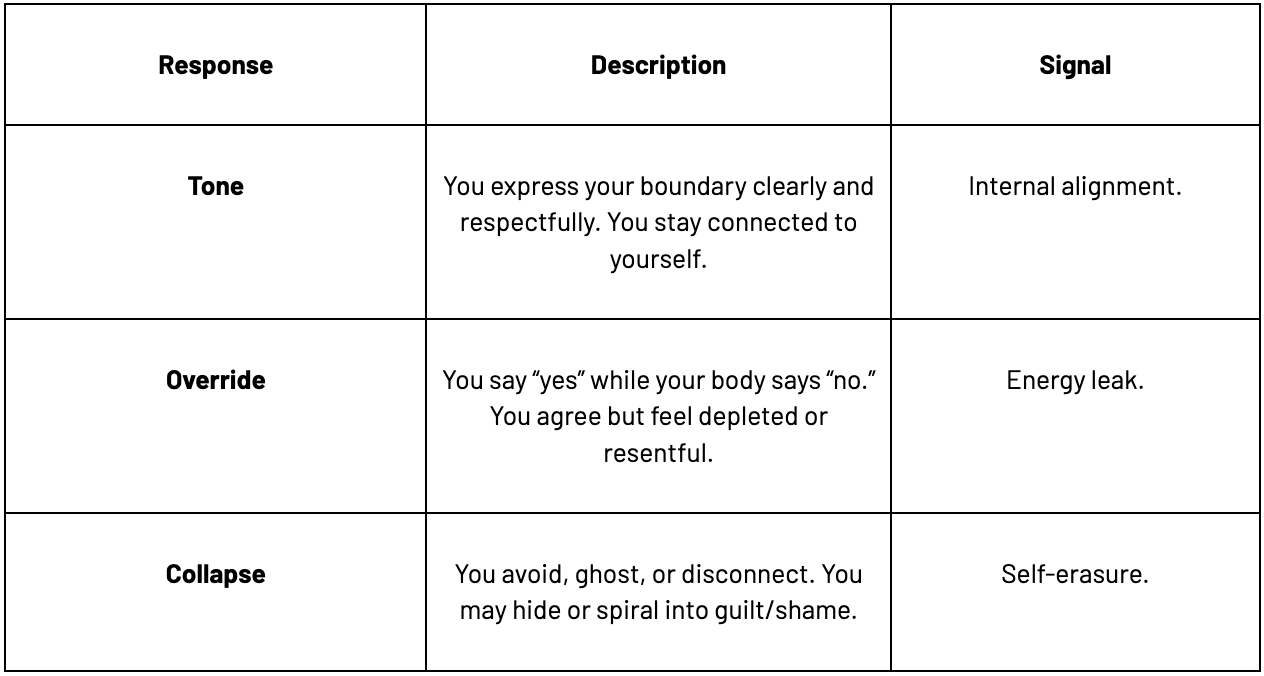
❹ Identify the Three Possible Responses
❺ Make the Choice
This is a practice — not a performance.
Tone doesn't mean:
“You have to do the scariest version now.”
It means:
“What is the most real step I can take without abandoning myself?”
Examples:
Hug the tree gently, even if for 5 seconds.
Touch its bark with reverence.
Walk barefoot 10 meters, then put shoes on.
Wear one piece that reflects you, even if subtle.
You’re building your field’s coherence — not proving anything.
❻ Stay Present During
Sensations may rise:
Heat in the face
Awareness of eyes on you
Thoughts like “What are they thinking?”
Come back to the why:
“I’m doing this because it’s mine. Not for them — for truth.”
Breathe slowly.
Feel your feet.
Let it complete.
❼ Review Afterwards
Ask:
“Did I meet myself honestly in that moment?”
“Where did fear win, and where did truth guide?”
“Can I celebrate that I showed up at all?”
Every time you do this, even in small ways,
your nervous system learns that your truth is safe to live.
That’s how tone becomes stable.
Not in theory — but in daily, embodied practice.
Threshold Example 03:
Boundary Setting — Saying “No” Without Collapse or Performance
⤷ Scenario
You’re in a situation where someone asks, expects, or assumes something of you.
It could be:
A friend wanting to talk when you need rest.
A family member pushing your limits.
Someone entering your space.
An event invitation you don’t have capacity for.
You feel:
“I don’t want to. I don’t have the energy. This doesn’t feel right.”
But then another voice:
“I should. They’ll think I’m selfish. It’ll be awkward.”
❶ Notice the Threshold
This is the pressure moment:
You feel the inner no
But you’re tempted to override it for the sake of comfort, image, or obligation.
❷ Name the Voices
Clarity comes when we separate signal from interference.
Voice A (Tone):
“I need space. I want to be honest. I can still be kind.”Voice B (Distortion):
“They’ll be disappointed. I’ll hurt their feelings. I have to explain everything.”
❸ Feel the Energetic Texture
Tone is steady, direct, and often quiet.
Distortion is tangled, performative, and circular.
Ask:
“If I weren’t afraid of disappointing them, what would I say?”
That’s your tone.
It usually doesn’t need justification — just clarity.
❹ Identify the Three Possible Responses
❺ Make the Choice
Tone doesn’t require a perfect script.
It requires presence.
Examples:
“I’m not available for that right now.”
“I’m listening to what I need, and that’s rest today.”
“I don’t feel up for this — thank you for understanding.”
Tone is not a debate.
It’s a clear note from your system’s truth.
❻ Stay Present During
Saying no can bring:
Tightness in the chest
Anxiety about their reaction
Guilt, second-guessing, inner noise
Stay with your tone:
“I’m not abandoning myself — I’m learning to stand with myself.”
Boundaries are a frequency.
The more you hold them clearly, the more the world organizes around them.
❼ Review Afterwards
Ask:
“Did I express the truth of what I needed?”
“Where did I soften the boundary out of fear?”
“Can I thank myself for practicing?”
Even if it felt messy, the fact that you chose yourself is the core.
That’s how inner authority becomes real —
not through control, but through coherence in expression.
Returning to the Compass
The Threshold Templates show how coherence plays out in everyday life.
But to access that kind of clarity in the moment, you need an inner orientation.
That’s what the Four Questions are for:
a daily check-in to help you feel where you are, and return to your tone before acting.
This isn’t about fixing yourself.
It’s about pausing long enough to feel what’s real.
The Four Check-In Questions: A Daily Compass
The following inquiries are not about solving your life.
They’re about locating yourself in real time.
Most of us have been taught to override our inner experience — to push through, make decisions under pressure, or act from urgency instead of truth. These four questions give you a moment to pause and feel what’s actually happening in your field.
They are not diagnostic tools.
They are vibrational orientation tools — helping you return to your tone before you respond to the world.
Whether you’re about to say yes, send a message, make a decision, or just start your day, these questions help you anchor into clarity without bypassing your actual state.
1. What is actually here in me?
Not what I should feel, not what I wish I felt — but what is truly here?
This anchors the moment in truth, not performance.
Are you tired?
Scared?
Numb?
Lit up?
Heavy?
Answer honestly. This is your vibrational baseline check.
2. What is the tone I choose now?
Even if everything feels distorted, what frequency do I choose to stabilize in myself?
Peace?
Stillness?
Dignity?
Self-respect?
Clear boundaries?
Spacious curiosity?
You are not forcing yourself to be happy. You are choosing the tone that holds your field in truth.
3. Can I let the echo pass without flinching?
Echoes = the residue of past fields:
Old trauma replaying
Incoherent relationships still showing up
Scarcity still appearing on the surface
This is where most people collapse: they mistake the echo for the present.
Can you stay in your chosen tone even when the world hasn’t caught up yet? Can you keep your hand steady on the tuning fork?
This is coherence in action.
4. What is available in this moment that matches my tone?
Once you’ve stabilized your internal field:
What is one real thing I can do, say, feel, or notice that matches this tone?
Examples:
Sit in silence for 3 minutes
Send a voice message from your real self
Take a walk without needing to get somewhere
Say no (or yes) clearly
Make food slowly, with presence
These are not steps toward manifestation.
They are acts of resonant coherence.
And they build a life — not based on getting, but on matching.
PART TWO
The Echo Phase:
Holding Your Signal Through Delay
Sometimes you’ve crossed the threshold — you’ve chosen a new tone, walked through the fear, and stayed with yourself. But when you look around... nothing’s changed. This part of the guide is for exactly those moments. Where you’ve already shifted — but your life hasn’t caught up yet.
Discernment: Signal or Echo
When your outer life doesn’t match your inner clarity, confusion often follows:
“Is this still my field? Or is it just the residue of what I used to carry?”
“Do I need to act on this? Or just witness it pass?”
This section helps you feel the difference between what is yours now—and what is simply passing through as echo.
What is a Signal?
A signal is a current vibrational truth.
It comes from your tone now — your real resonance — and doesn’t need urgency or validation.
It often feels quiet, but clarifying.
Real-life examples of a signal:
You realize mid-conversation that you're done explaining yourself — not from anger, just from clarity.
You wake up knowing you need solitude today. Not from collapse, but from real need.
You suddenly sense: “This is not the relationship I want to be in anymore.” There’s grief, but also steadiness.
You cancel a plan — not to avoid, but because your body and field say, “No, I need rest.”
Signals are often small but undeniable.
They clarify without needing to convince.
What is an Echo?
An echo is a delayed reflection — a field residue from a previous tone, decision, belief, or pattern.
It often feels familiar, sticky, or looping. It’s not alive — it’s echoing.
Real-life examples of an echo:
You suddenly panic about money — but nothing has changed in your finances. It’s the same fear from a past phase, resurfacing.
You get an urge to reach out to someone you’ve already closed the loop with. The feeling feels old, not grounded.
You feel ashamed after saying no — even though you were clear. The shame is from an old identity, not your now.
A text message triggers a wave of anxiety — but the situation is neutral. It’s the past reacting, not your tone.
Echoes tend to come with urgency, looping thought, or emotional stickiness — but no real clarity.
They are here to release, not to be re-entered.
3-Question Field Diagnostic
Use these questions when you're not sure what you're dealing with:
1. Is this experience in alignment with my current tone?
Does this feel like me now, or like an older version of me?
→ If it feels outdated or misaligned, it’s likely echo.
2. Does this situation bring clarity, or fog?
Does it energize my presence, or pull me into loops?
→ Signal sharpens. Echo loops.
3. Do I feel grounded while sensing this?
Can I hold it in stillness without flinching or needing to fix it?
→ If yes, it's likely a signal.
→ If it causes you to rush, justify, or shrink—it’s probably echo.
Practice: Witness Without Re-entry
When an echo surfaces:
Acknowledge it: “Ah, there you are. A familiar shape.”
Do not deny it—but don’t merge with it.
Let it move through like sound in a canyon.
Say: “This was once me. But it is no longer my tone.”
This allows the echo to dissolve without reinfection.
Not every moment of doubt or discomfort means something is wrong.
Sometimes, it’s just a familiar shape rising — an old signal, a past version of you, a habitual loop.
These are what we call echoes.
They show up as hesitation, looping thoughts, emotional tightness, or uncertainty — but they’re not grounded in your current truth.
They’re fragments of a tone you used to carry.
In contrast, a true signal is clear, even when it’s quiet.
It doesn’t need convincing — it simply is.
This section offers three everyday moments where echoes commonly appear.
You may recognize them — not as dramatic turning points, but as the quiet friction that shows up right before something true wants to move through.
Learning to spot these echoes in real time is one of the most powerful ways to stay in coherence.
3 Echo Moments Most People Will Recognize
With guidance on how to feel the difference between echo and real signal
1. The ‘Should I Post This?’ Echo
You just wrote something honest — maybe on social media, maybe in a message.
It’s not dramatic, it’s just true.
But before you hit send…
You hesitate.
Suddenly, a wave of thoughts:
“Maybe this is too much.”
“Who do I think I am?”
“What if nobody responds… or worse, what if they do?”
What’s happening:
A familiar echo is surfacing — often from earlier times when your realness wasn’t safe or welcomed.
It may be the echo of invisibility. Or shame. Or being told you're "too intense."
How to recognize it:
The energy loops: you rewrite it 3 times, your chest tightens, you want to hide.
The tone is urgent or slippery — not grounded.
It feels like you're not safe unless you edit yourself.
How to meet it:
→ Pause.
→ Breathe into what’s actually true underneath.
→ Ask: “Is this too much — or just more me than I’m used to being seen as?”
→ If it still feels clear beneath the noise — post it. From coherence, not defense.
2. The ‘Why Am I So Sensitive?’ Echo
You’re in a group — maybe at work, or with friends.
A subtle jab is made. A joke that cuts just a little too close.
Or you feel the tension in the room that no one’s naming.
You go quiet. But inside: your body tightens, your heart races.
Later, alone, you think:
“Why did that affect me so much?”
“Maybe I’m overreacting…”
“I need to toughen up.”
What’s happening:
This is an echo of self-abandonment — often learned early on in fields that didn’t validate sensitivity, subtlety, or truth that didn’t match the group tone.
How to recognize it:
You start to doubt your inner signal, even when it was clear in the moment.
You feel a push to dismiss or "fix" your reaction, rather than feel it.
How to meet it:
→ Acknowledge: “I noticed something real.”
→ Ask: “Is this reaction an old wound? Or did I just pick up something others won’t name?”
→ Stay with the feeling, without labeling it wrong.
→ You’re not too sensitive. You’re just no longer pretending.
3. The ‘I Should Be Further By Now’ Echo
You see someone else doing what you want to do.
They’ve launched the project, shared their truth, are being seen.
A mix of feelings rushes in:
“I’m behind.”
“I’ve missed my chance.”
“They’re special — I’m just… me.”
What’s happening:
An echo of comparison — rooted in a false idea that there’s a limited amount of space, time, or worth.
It’s an echo of the scarcity field — that if someone else is shining, it means there’s less for you.
How to recognize it:
You feel small, tight, or ashamed.
You forget who you are.
Your energy pulls outward — away from your own tone, toward theirs.
How to meet it:
→ Say: “This is an old pattern. It’s not my truth.”
→ Remind yourself: “Their timing doesn’t erase mine.”
→ Tune back into your body. Your pace. Your own unfolding.
→ Then… act from there. Even if it’s just one small movement forward.
Reflection:
Most people have been trained to override, collapse, or distract when echoes arise.
But every time you stay, feel, and re-tune — you’re restoring your coherence.
You don’t need to be perfect.
You just need to stay close to your own tone.
Coherence Threshold Symptoms
When you start living from your tone — moment by moment — something starts to shift.
Not just internally, but structurally.
Your system begins to de-pattern, and your field starts reorienting around a truer signal.
This is a real vibrational process — and often, it doesn’t feel “light” at first.
Crossing a coherence threshold isn’t a bliss-state.
It often begins with disorientation, tension, rupture, or loss — not because you’re regressing, but because your field is reorganizing around a more stable truth.
You’re no longer holding together the version of you that was adapted, compliant, or split.
You’re tuning into something deeper — and that process creates friction.
Like adjusting a violin mid-song:
The note becomes clearer, but not without pressure.
This is not collapse.
It’s not failure.
It’s what crossing into a new coherence band actually feels like.
Common Threshold Symptoms
1. Disorientation or fog
You may feel:
Confused about direction or identity
Unable to access previous strategies
Like nothing makes sense anymore
This isn’t regression. It’s unbinding from old anchors that no longer match your tone.
2. Grief with no clear source
Suddenly, tears. Or heaviness. Or a hollow ache.
You might not know why.
That’s because:
You’re grieving not just people or moments—
But entire identities you no longer need.
Even joy can carry grief, as the system says goodbye to what was once survival.
3. Longing, ache, or homesickness
A subtle (or sharp) feeling like:
“I miss something I’ve never had.”
“There must be something more.”
“I’m not fully here yet.”
This is your tone calling you forward.
Not to escape the present—
But to let the signal of your real life begin to take shape.
4. Sudden stillness or internal clarity
Out of nowhere:
Peace
Calm
Knowing
This may feel suspicious at first (“Am I dissociating?”), but check:
If the stillness is resourced, present, and clear, it’s not dissociation.
It’s integration.
Your system is holding itself at a new frequency.
5. Rejection of old relationships, systems, obligations
You might feel:
“I can’t do this anymore.”
“I don’t belong here.”
“This was never really true for me.”
This is not about blame.
It’s the field saying:
“This resonance is no longer yours. Let it fall away.”
A Note Of Reassurance
All of these symptoms can feel like loss.
But they are signs of release, not regression.
Your system is:
Dropping false tone
Disengaging from fields that used to define you
Creating spaciousness for what actually matches
It may feel empty at first. That’s okay.
Emptiness is not failure.
It is the clearing that allows your real life to land.
Field Behavior: Why Life Takes Time to Reorganize
Reality doesn’t shift like a vending machine.
You don’t insert your clarity and instantly receive the new result.
That’s because life responds not just to your desires, but to your vibrational baseline —
and baseline coherence takes time to stabilize in the field.
Most of your current environment was shaped by past tone entrainments —
your former frequency of survival, compliance, or override.
Even though you're showing up differently now, you're still seeing the echo of that old resonance.
This is not spiritual punishment.
It’s just field behavior — the outer reorganizes in delay, as the inner stabilizes in truth.
In vibrational mechanics terms:
Your tone emits consistently over time.
Life entrains to that tone.
But entrainment is not instant — it’s responsive, layered, and sometimes slow.
The more truth you hold, the more deeply life reorganizes around it.
So the delay is not dysfunction.
It’s proof the field is recalibrating — not just reacting.
The Compass exists to help you hold your new tone long enough
for that realignment to complete.
Map Of The Echo Timeline: When what you're living is not what you're vibrating now
One of the most confusing parts is this:
You’ve changed—but your life still looks like the old version.
This can lead to doubt:
“Am I not actually different?”
“Why is this still happening if I’ve already let go of it?”
But the truth is:
Most of reality is experienced on a delay.
You are often witnessing the echo of your past field—not the signal of your current one.
The Echo Timeline (simple form):
Old Tone → Field Shape → Physical Reality → Lag → Restructuring → Alignment
In human terms:
Unconscious wound → Survival field → Echo experiences → You change → World still looks the same → Eventually matches you
Important Notes:
The delay is not your failure. It’s field mechanics.
The outer reality you see today was likely structured weeks, months, or even years ago.The echo wants a reaction.
That’s how it loops. Your job isn’t to fight it, but to hold tone anyway.If you chase the echo, you reinforce it.
But if you hold your true tone through the echo, it begins to dissolve.
When you're facing old patterns reappearing:
Ask: “Is this a reflection of my now? Or just the wave still coming in from before?”
Say: “This is not who I am anymore. But I’m strong enough to meet what still remains.”
Know: You are not being punished.
You are just witnessing the tail-end of a signal you already stopped sending.
Coherence ≠ Manifestation
This Compass is not about manifesting results.
It’s not about proving you’ve healed.
It’s not about creating a perfect life.
It’s about:
remembering, and being who you naturally are —
and allowing life to reorganize around your stabilized tone.
Not through force.
Not through mental rehearsal.
Not through bypass.
But through staying clear in your signal —
even while the echo of your past field is still dissolving.
Why People Get Confused
Many people get disoriented right here.
They’ve done the inner work.
They’ve followed their truth.
But because life still feels slow to respond, they start to question:
“Isn’t this supposed to work?”
“If I’m aligned, why is nothing changing?”
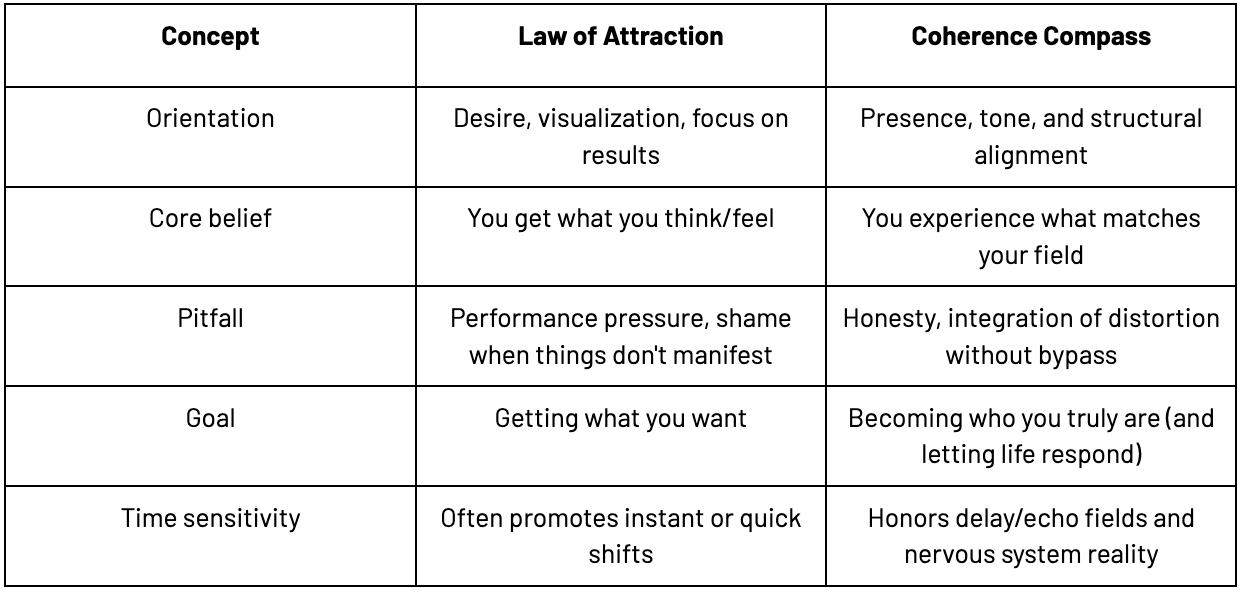
It’s often because they’re still viewing their path through the lens of manifestation logic —
where what you want, feel, or visualize should directly create results.
But coherence doesn’t work like that.
It doesn’t bypass time, biology, nervous system reality, or the natural delay of field reorganization.
It reorganizes reality not instantly, but structurally.
Let’s clarify the difference:
Integration: What This Looks Like In Real Life
You wake up anxious. You don’t try to "fix" it. You acknowledge it. You ask, "What tone do I choose now?" You land in steadiness. You carry that steadiness to your tea, to the body, to the tasks.
You want financial support, but scarcity still appears. You recognize it as an echo, not a verdict. You breathe. You take an aligned step anyway.
You desire connection. But instead of grasping, you feel your own resonance, and let that be the signal. Someone replies later, and the tone matches.
This is not a technique.
It’s not spiritual performance.
It’s returning to structural integrity.
And from there:
Life doesn’t need to be controlled. It organizes itself.
The Role Of Desire (And Its Distortion)
Desire is not the problem. The distortion around it is.
In most teachings (especially Law of Attraction), desire is positioned as a magnet:
"Want it hard enough, and it will come."
But desire from lack — or desire as performance — creates inner incoherence. It scrambles your tone.
Clean Desire vs. Distorted Desire
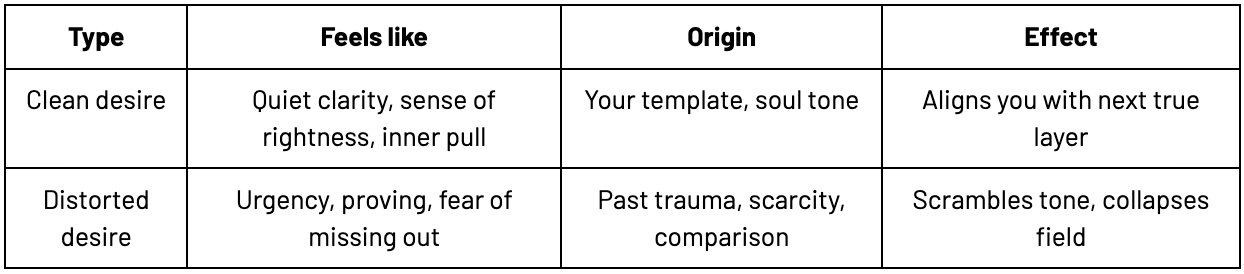
Desire is not about getting. It’s about resonant direction.
Clean desire arises when something in life matches your coherence band, and you feel it like a click.
It doesn’t scream. It doesn’t chase. It aligns.
Instead of asking:
How do I make this happen?
Try:
What tone is this desire asking me to live now?
Can I match the frequency of this desire before the outcome appears?
If yes, the desire is a directional tuning fork. If no, it may be an echo of unprocessed lack.
Let desire return to its rightful role:
A soft pulse from your original tone, guiding you home.
Coherence And Collective Fields
Your coherence doesn’t end with you.
When you stabilize your tone, you're not just organizing your own life — you're shifting the frequency of the field around you.
In a world full of noise, fear, and energetic fragmentation, clarity is felt.
People may not name it, but they sense it.
And in this way, coherence is contagious — not because you're trying to change others, but because you're no longer broadcasting distortion.
But this doesn’t mean it’s your job to fix the field.
In fact, for many sensitive or aware systems, the greatest temptation is to either collapse into collective incoherence or to overextend in trying to fix it.
Neither is coherence.
You are not here to fix the collective field.
You are here to stabilize your tone within it.
And from there, the field will begin to reorganize on its own —
not through force, but through the presence of one held signal at a time.
The Physics of Influence
Every coherent being becomes a stabilizer in the field.
Not by doing more.
Not by convincing others.
But simply by being steady in their signal.
This is not metaphorical.
It is literal vibrational impact.
A human being in sustained coherence becomes like a tuning fork in a noisy room. Not the loudest. But the one that begins to reorganize the interference pattern around them.
Even when unseen. Even when alone.
Why Your Clarity Matters
“But I’m just one person…”
You are not just a person.
You are a node.
An expression point of the entire field.
And every stabilized node strengthens the lattice.
Even if:
You don’t speak
You are misunderstood
Nothing changes around you for a long time
Your field is still working. It is felt.
Every internal act of coherence:
Choosing presence instead of urgency
Returning to your tone instead of chasing approval
Feeling truth even when no one validates it
—is a planetary act.
Mini Tone Return Practices
No one holds perfect coherence all the time. Striving for perfection is not what this is about.
Even when we know our truth, the field can wobble — especially under pressure, conflict, or old patterns.
In those moments, the work is not to force clarity.
It’s to gently return to signal.
That’s what these practices are for.
They don’t bypass or override what’s here.
They help re-tune the nervous system back into coherence — softly, honestly, without needing to fix anything.
This isn’t about spiritual performance.
It’s about creating micro-bridges back to yourself.
Following are some embodied ways to bring yourself gently back into coherence.
These are not just affirmations. They are frequency anchors. Each one carrying a felt geometry — a way to softly realign the field without bypassing what's real.
Use these in daily life, quietly. Silently. Out loud. On paper. In your body.
Core Phrases (Mantra-like)
“I return to the truth of me.”
“This, too, is passing through.”
“My tone is steady. Even now.”
“I am allowed to take up space.”
“I exist. That is enough.”
Say slowly. Let the words settle into the nervous system.
Breath-Based Anchors
Inhale: I welcome what’s here.
Exhale: I stay with myself.Inhale: I open.
Exhale: I ground.Inhale for 4, hold for 4, exhale for 6 — repeat 3x. (This pattern gently shifts the vagus nerve into regulation.)
Physical Grounders
Place both hands on your belly. Press gently. Breathe.
Stand barefoot on ground or floor and say: “Here. Now. Safe.”
Hum softly for 1 minute. Feel vibration in your chest.
Lie on the floor. Let your weight drop fully into gravity.
Gentle Inner Phrases
To use when looping, spiraling, or overwhelmed:
“I don’t need to solve this right now.”
“This feeling is valid. And it will move.”
“What if I trusted that I’m already on the path?”
These do not erase discomfort.
They return coherence to the field that is currently holding it.
Coherence is not perfection. Coherence is integrity. Coherence is tone, held.
The Collective Doesn’t Need Saving
You don’t need to convince the world of your tone.
You just need to live it — consistently, gently, and without apology.
Coherence is not the end result.
It’s the frequency you return to — until it becomes where you live.